A source-led biographical collection tracing women’s documented lives and contributions across the Ismaili world and its study, from the medieval period to today.
Historical classification: this collection includes women in the shared early and Fatimid Ismaili past, later Nizari communities, and scholars of Ismaili history. Inclusion is not a claim that every historical figure belonged to the Nizari branch. Succession after 1094 and the identities of other Ismaili traditions are distinguished where relevant.
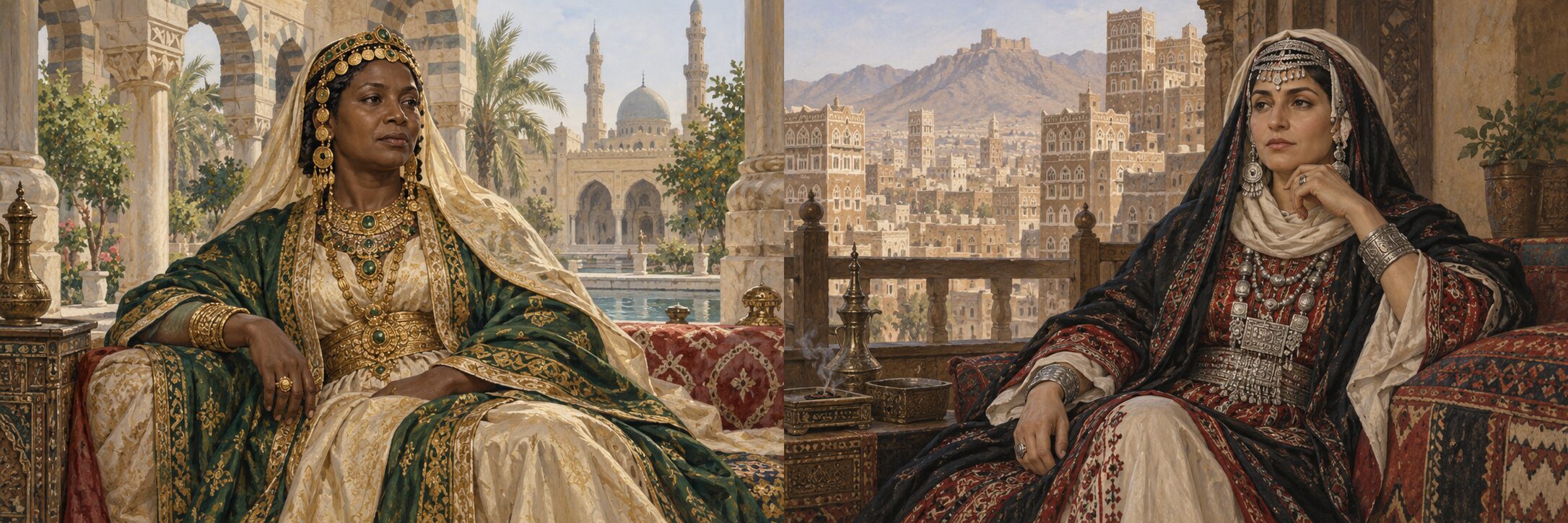
Editorial note: the early historical record is uneven. For the six pre-modern women shown with artwork, no authenticated contemporary portrait is presented here; each image is an AI-assisted artistic interpretation, not documentary evidence. Modern portraits link to their original institutional or archival sources.
Historical leadership, learning and literature
AI-assisted artistic interpretation; no verified contemporary portrait is known.
Fatimid Egypt · political leadership
Sitt al-Mulk
970–1023 CE
Sitt al-Mulk was born in 970 in the Fatimid palace, the daughter of al-Aziz bi’llah and al-Sayyida. Her title means “Lady of the Empire.” She became a prominent entrepreneur and wielded influence at court during her half-brother al-Hakim’s reign. When he disappeared in 1021, she secured the accession of his son al-Zahir and acted as regent, exercising de facto authority during the early years of his rule. Her career unfolded amid competing court factions and disputes over succession, so chroniclers’ accounts of her actions require careful comparison. She died in 1023, leaving the Fatimid state under al-Zahir.
AI-assisted artistic interpretation; no verified contemporary portrait is known.
Yemen and Gujarat · ruler and hujja
Queen Arwa al-Sulayhi
c. 1048–1138 CE
Arwa al-Sulayhi, born in Haraz around 1048, was orphaned young and raised at the Sulayhid court by her relatives Ali al-Sulayhi and Asma bint Shihab. Her education prepared her for public leadership. She married Ahmad al-Mukarram in 1066 and became politically active as his health declined; after his death in 1084 she governed first as regent for their son, then as sovereign in her own right from about 1097 until her death in 1138. The Fatimid Imam-Caliph al-Mustansir appointed her hujja of Yemen, giving her high religious authority as well as political leadership. She also directed the Ismaili mission in Yemen and western India.
AI-assisted artistic interpretation; no verified contemporary portrait is known.
Iran and India · community leadership
Bibi Sarkara Maryam Khatun (Mata Salamat)
18th–19th century
The Institute of Ismaili Studies identifies Maryam Khatun as the wife of Imam Shah Khalil Allah and mother of Hasan Ali Shah, later Aga Khan I; it does not provide a firm birth year. A community-published Ismaili historical text gives her birthplace as Iran and birth year as 1744, a detail not confirmed in the IIS biography. After her husband was killed in 1817, she sought justice from the Qajar court and helped safeguard her son’s succession. Later she travelled to India as Pir Mata Salamat, preached and helped settle community disputes. The IIS article’s body gives her death as Kutch in 1851, while its heading differs, so her death date is disputed.
AI-assisted artistic interpretation; no verified contemporary portrait is known.
South Asia · devotional literature
Sayyida Imam Begum
d. c. 1866 CE
Sayyida Imam Begum is remembered as a female composer of ginans, devotional poems in the South Asian Ismaili tradition. Published sources reviewed do not securely establish her birth, family, education or a complete life chronology. Her compositions survive within a tradition transmitted through performance and community memory, so individual attributions and biographical details require care. The Institute of Ismaili Studies recognizes her as one of the best-known women associated with ginan composition. This profile records that literary and devotional contribution while leaving unknown personal details marked as unknown rather than supplying an unverified life story.
Archival portrait, Le Journal (1930), CC0 via Wikimedia Commons.
South Asia and East Africa · community leadership
Begum Um Habibeh (Yvonne Labrousse)
1906–2000
Born Yvonne Blanche Labrousse in Sète, France, in 1906, she preferred the name Yvette. Before marriage she worked as a model and won a national beauty title, including Miss France in 1930, then travelled widely and lived in Egypt, where she embraced Islam. She married Imam Sultan Mahomed Shah Aga Khan III in Switzerland in 1944 and became Begum Um Habibeh. After his death in 1957 she continued charitable and community work, later establishing a retirement home in Le Cannet, France. She died on 1 July 2000 and was buried beside her husband in Aswan, Egypt.
Portrait from Farkhunda Zahra Naderi's official website.
Afghanistan · politics and women's rights
Farkhunda Zahra Naderi
born 1981
Farkhunda Zahra Naderi was born in 1981 in Kayan, Baghlan, into a family active in Afghan Ismaili community life. She began her education in Afghanistan, completed secondary studies in the United Kingdom and earned a law degree from Westminster International University in Tashkent. Elected to Afghanistan’s parliament in 2010, she became president of the Inter-Parliamentary Union’s Committee on Democracy and Human Rights in 2014—the first Afghan MP elected to one of its standing committees. She has spoken about human rights, women’s political participation and the choice to engage directly in public service. After the political transition in 2021, she served on Afghanistan’s High Council for National Reconciliation until 2022.
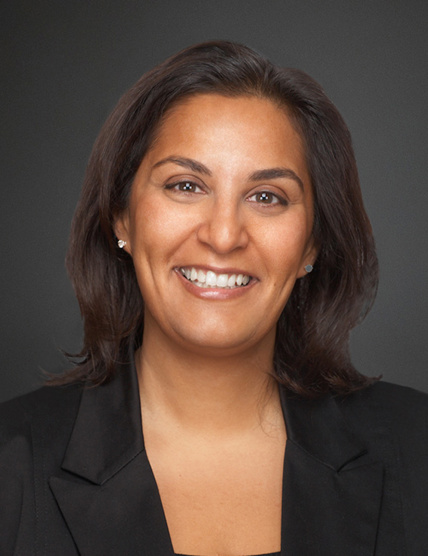
Princess Zahra Aga Khan, born in 1970, is the eldest child of the late Aga Khan IV. She attended Le Rosey in Switzerland and graduated cum laude from Harvard in 1994 with a degree in Development Studies. For more than three decades she has held policy and management responsibilities in the Aga Khan Development Network, especially in health, education, planning and building services, and has served on institutional boards. She joined the Aga Khan University Board of Trustees in 2003 and was appointed Pro-Chancellor in 2025. Her work has connected long-term development policy with the governance and growth of AKU and other AKDN institutions.
Canada and Eritrea · diplomacy and gender equality
Nahla Valji
contemporary
Public biographies do not give Valji’s birth or childhood details. She holds a master’s degree in Political Science and International Relations and a joint diploma in Forced Migration Studies from York University. Her career began in South Africa, including work on human rights and gender-responsive budgeting and transitional justice; she helped found and edit the International Journal of Transitional Justice. She joined the UN in 2010, held senior roles at UN Women, led the Secretariat for the 2015 Global Study on Security Council Resolution 1325, and later served as Senior Gender Adviser in the Secretary-General’s Executive Office and head of the Spotlight Initiative. Appointed UN Resident Coordinator in Eritrea in 2024, she continues in that role.
Artistic interpretation; no verified portrait is known.
Fatimid Egypt · regency
Rasad, mother of al-Mustansir
active c. 1036–c. 1070s
Rasad’s birth date and early life are not securely documented. Medieval accounts describe her as a woman of Nubian or Sudanese origin who entered the Fatimid palace and became the mother of al-Mustansir. When her son succeeded to the throne as a young child in 1036, she served as regent and came to dominate political affairs for decades; by the mid-1040s she was publicly styled queen in state documents. Her authority later diminished as military factions and powerful viziers gained control, though she remained an influential queen mother. The surviving evidence is filtered through court chronicles, and her precise death date remains uncertain.
Artistic interpretation; no verified portrait is known.
Yemen · statecraft and education
Asma bint Shihab
d. 1074 CE
Asma bint Shihab was the cousin and wife of Ali al-Sulayhi, founder of Yemen’s Sulayhid dynasty. She took an active part in state affairs and helped educate Arwa, the future queen, at the Sulayhid court. After Ali was killed by the Najahids in 1067, their son Ahmad al-Mukarram succeeded him with Fatimid investiture; Asma supported her son’s government, as she had supported her husband’s rule. Her political activity was unusual in its setting and is preserved mainly in Ismaili historical accounts. She died in 1074, after which Arwa became the effective ruler of Sulayhid Yemen.
Archival photo c. 1963; image credit: Ismaili Special Collections Unit.
Punjab · girls’ education
Vazir Saheba Hajjan Ghulam Fatimah
1889–1967
Born Sobha Devi in Amritsar in 1889, Vazir Saheba Hajjan Ghulam Fatimah later became known for her work in Gujranwala, Punjab. According to an IIS oral-history account based on family testimony, she left secure employment as a midwife and began teaching girls in a family courtyard with Saleha Bibi. The two women canvassed local households, taught without fees and organized a women-led association to acquire land for a permanent school. The Chaudhry Fateh Din Girls’ Islamia High School later expanded into branches and continued serving generations of students. Fatimah also taught Qur’an reading to neighbourhood girls and remained active in community life; the oral-history source preserves both the achievements and limits of the family record.
پرترهٔ تأییدشدهای از صالحهبیبی پیدا نشد؛ این تصویر جاینگهدار، پرتره نیست.
Gujranwala · community education
Saleha Bibi
dates not established
Saleha Bibi is known through an IIS oral-history project as the educational partner of Vazir Saheba Ghulam Fatimah in Gujranwala. The family account recalls that the two women began teaching girls on rugs in a courtyard because the area lacked a Muslim school for girls. They visited households to encourage enrolment, charged no fees and raised money for supplies; they then organized women collectively to secure land and establish a permanent school. The Chaudhry Fateh Din Girls’ Islamia High School later developed branches and continued its educational work. Published sources offer few independent biographical details about Saleha’s childhood or later life, so her documented educational contribution is clearer than her private biography.
These nine scholars are included for documented research on Ismaili and Shi'i history and communities. The IIS profiles do not establish all their religious identities; this section records their scholarship and does not infer affiliation.
Photo: Institute of Ismaili Studies.
Lecturer, historian and author; IIS governor
Dr Nadia Eboo-Jamal
documented career
The sources reviewed do not give Nadia Eboo-Jamal’s birth or childhood details. She earned a PhD in Near Eastern Languages and Literature from New York University in 1996 and became a historian of Persian history and culture under Mongol rule, especially the Nizari Ismailis. Her book Surviving the Mongols (2002) follows the community’s networks and continuity through the Mongol period. She has taught and supported religious education in the United Kingdom and United States, contributed to IIS curriculum materials, and serves on the IIS Board of Governors.
Public biographies do not state Jiwa’s birth or childhood. Her education is documented: BA in Political Science and Philosophy at the University of Karachi (1979), MLitt at Edinburgh (1981), an MA through the IIS–McGill programme (1984), and a PhD in Islamic Studies at Edinburgh (1989); she later completed counselling and academic-practice qualifications. She has spent over 25 years at IIS in research, teaching, curriculum and leadership, and is now an Associate Professor and founding editor of the World of Islam and Living Ismaili Traditions series. Her books include The Fatimids: The Rise of a Muslim Empire (2017) and The Rule from Egypt (2023).
No reliable birth or childhood account was located. Kassam earned a diploma in Hindustani classical vocal music at the University of Bombay (1982), a BA in Philosophy and Religion at McGill (1984), and a PhD in History of Religions at McGill (1993). Since 2000 she has taught at Syracuse University, where she is an Associate Professor of Religion. Her scholarship examines gender, ritual, devotional literature and South Asian religious life; Songs of Wisdom and Circles of Dance (1995) studies the Ismaili ginan tradition and its Hindu-Muslim setting.
Born and raised in Kenya, Zayn Kassam attended Aga Khan primary schools in Kisumu, Mombasa and Nairobi, then Aga Khan High School in Nairobi, graduating in 1972. She moved to Canada for university and earned a BA in Religious Studies, an MA in Islamic Studies and a PhD in History of Religions at McGill, specialising in medieval Islamic and Indian philosophy. She taught at Pomona College for many years, where she also held leadership roles and won teaching awards. She is Director of the Institute of Ismaili Studies and Head of its Department of Academic Research; her writing also covers gender, environment, migration and religion.
Gender and Muslim societies scholar; Georgetown University
Dr Shenila Khoja-Moolji
documented career
Khoja-Moolji grew up in Hyderabad, Pakistan. In her autobiographical account, she recalls that the 1971 war displaced her family to Karachi, where as a child she helped make bhel puri for a canteen near the local jamatkhana. She later pursued graduate study in education and feminist theory and became a scholar of Muslim communities, gender, race, displacement and power. She holds the Hamad bin Khalifa al-Thani Endowed Chair of Muslim Societies at Georgetown University. Her books explore girls’ education, political belonging and displaced Shia Ismaili women; she has also served Ismaili community councils and educational programmes.
No verified portrait located; placeholder is not a portrait.
Historian of early Shi'i thought and medieval Arabic
Dr Arzina Lalani
documented career
Lalani earned a doctorate in Arabic and Middle Eastern Studies at the University of Edinburgh and served as a researcher, writer and lecturer at the Institute of Ismaili Studies. Her work examines early Shi‘i thought and the formation of Imami doctrines, including the teachings of Imam Muhammad al-Baqir. Her award-winning Early Shi‘i Thought (2000) has been translated into several languages. She later edited and translated Aḥmad al-Naysābūrī’s Fatimid treatise Kitāb ithbāt al-imāma as Degrees of Excellence (2009), alongside publishing scholarly articles. The sources reviewed do not give her birth or family details.
Miskinzoda completed a BA with distinction (1998) and MA with distinction (2000) in Arabic and Persian studies at Moscow State University, a PhD at SOAS in 2007, and an MBA in Higher Education Management at UCL in 2019. She has taught since 2004 and joined IIS in 2007, where she held research, scholarship and Shi‘i Studies coordination roles. She teaches on IIS graduate programmes and is Managing Editor of its Shi‘i Heritage Series. Her research spans the history of Islam to the seventeenth century, Arabic and Persian literature, and Shi‘i historical traditions; she co-edited The Study of Shi‘i Islam (2014).
Scholar of Khojki manuscripts and South Asian Ismaili traditions
Zawahir Moir
documented career
Born Zawahir Noorally in Karachi in 1933, she earned a BA in Arabic and Islamic Culture (1956) and a master’s in Islamic History (1958) at Karachi University. An Aga Khan scholarship took her to SOAS in London for a further MA. She returned to Karachi and worked with the Ismailia Association for Pakistan for nearly 15 years, then moved back to London in 1979. At IIS she catalogued Khojki manuscripts and continued teaching the script after leaving. A pioneer in Satpanth and ginan studies, she co-authored Ismaili Hymns from South Asia (2001). She died in London on 9 February 2024, aged 91.
No verified portrait located; placeholder is not a portrait.
Film and visual culture scholar; University of Edinburgh
Dr Nacim Pak-Shiraz
documented career
The sources reviewed do not give her birth or childhood details. Pak-Shiraz completed a BA in Tehran, the IIS Graduate Programme in Islamic Studies and Humanities, an MA in Anthropology of Media, and a PhD in Film and Media. She became Personal Chair in Cinema and Iran and Head of Islamic and Middle Eastern Studies at the University of Edinburgh, and serves on the IIS Board of Governors. Her work studies visual culture, gender and religion in film; Shi‘i Islam in Iranian Cinema (2018) and Visualizing Iran: From Antiquity to the Present are among her books.
Uganda and Canada · girls’ education and public service
Senator Farah Mohamed
born in Kampala; appointed senator 2025
Born in Kampala, Uganda, Mohamed came to Canada as a refugee child after the 1972 expulsion of Asians from Uganda and grew up there. She studied at Queen’s University and the University of Western Ontario, then worked in public service, philanthropy and youth development. In 2010 she founded G(irls)20, later led the Malala Fund and The King’s Trust Canada, and was appointed to the Canadian Senate on 7 March 2025. The Ismaili community profile describes her upbringing in the Ismaili Muslim faith.
Canada and Africa · humanitarian and development service
Zahira Virani
UN development leader · current role in Central African Republic
The public biographies reviewed focus on Virani’s education and career and do not give her birth date or childhood. An IIS graduate (GPISH, 1997), she earned an MSc at the London School of Economics and has more than two decades of humanitarian and development experience. She served as Resident Coordinator in São Tomé and Príncipe and Angola, then moved to the UNDP Resident Representative role in the Central African Republic in 2025. The IIS identifies her as an alumna in its Ismaili studies programme.
Uganda and Canada · public service and community leadership
Salma Lakhani
born in Kampala · Lieutenant Governor since 2020
Born and raised in Kampala, Lakhani grew up in an Ismaili Muslim community and studied at Aga Khan School before completing an honours degree in clinical biochemistry at the University of Manchester. During Uganda’s 1972 expulsion of Asians she became stateless; she later settled in Edmonton with her husband in 1977, became a Canadian citizen and built a career in early-childhood education and volunteer service. She served many Alberta community organisations and became the province’s 19th Lieutenant Governor on 26 August 2020; she remains in office in the current official biography.
This expanded directory contains 24 named profiles. It is not yet a complete list of every influential Ismaili woman: records from the first centuries and local histories often omit women’s names and life details. Several biographies are limited to what reliable sources document; HSKRC will extend them when more evidence is found.